
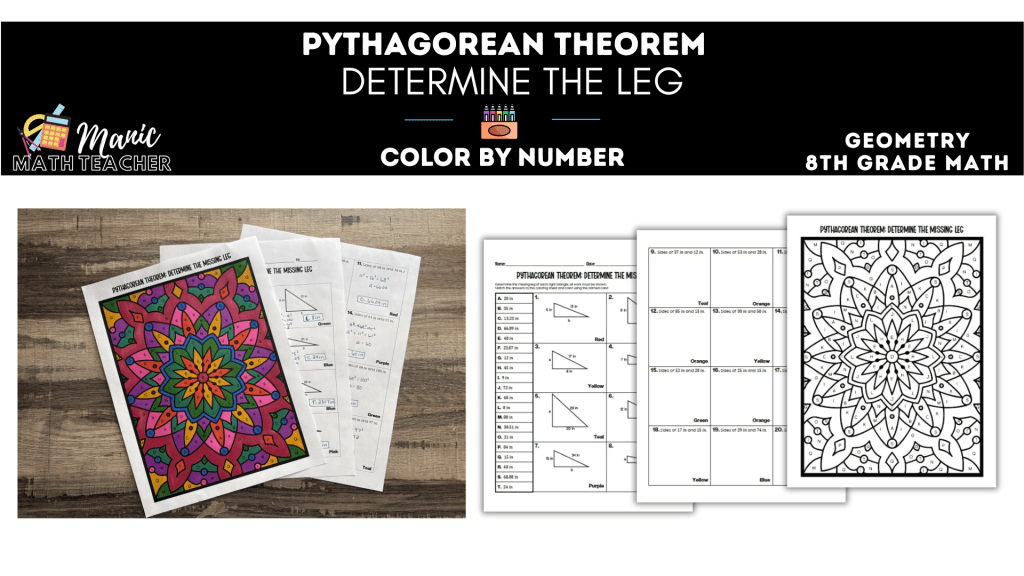
Once students can comfortably find the hypotenuse, the next hurdle is using the Pythagorean Theorem to work backward. This is where many students get stuck—especially when they need to solve for a leg instead of the longest side.
Studies on problem types show that students benefit from “bidirectional” practice: the chance to use a formula both forward and backward. When they only ever solve for , their brains label it as a one‑direction process. Asking them to find a missing leg forces them to think more flexibly about the relationship between the sides of a right triangle.
In practice, that means designing tasks where students are given one leg and the hypotenuse and asked to find the other leg. We want them to notice that the structure is the same—square, subtract, square root—but the interpretation is different. The more varied examples they see, the less likely they are to freeze on a test when the problem doesn’t look exactly like the notes.
To keep this from turning into “just another worksheet,” I use a color by number format. Students calculate the missing leg, match it to an answer bank, and then use that information to color a design. It’s still rigorous practice, but the built‑in self‑checking and coloring piece reduce anxiety and keep them working.
If your students can find the hypotenuse but struggle when the missing side isn’t the longest one, this kind of focused practice can make a big difference. You can find my “missing leg” Pythagorean color by number activity on TpT and plug it right into your unit.
This product can be found on my Teachers Pay Teachers Store here:


Leave a comment