
One of the biggest shifts in middle school geometry is moving from memorizing formulas to actually understanding where they come from. The Pythagorean Theorem is a perfect example. When students only see it as “that formula with ” they may plug in numbers correctly but have no sense of what the hypotenuse represents or why the relationship works.
Research on conceptual understanding in math shows that students learn more deeply when they connect representations—diagrams, numbers, and words—rather than practicing procedures in isolation. When we give them repeated practice finding the hypotenuse using both visual triangles and real‑world contexts, they start to see the theorem as a tool, not just a rule.
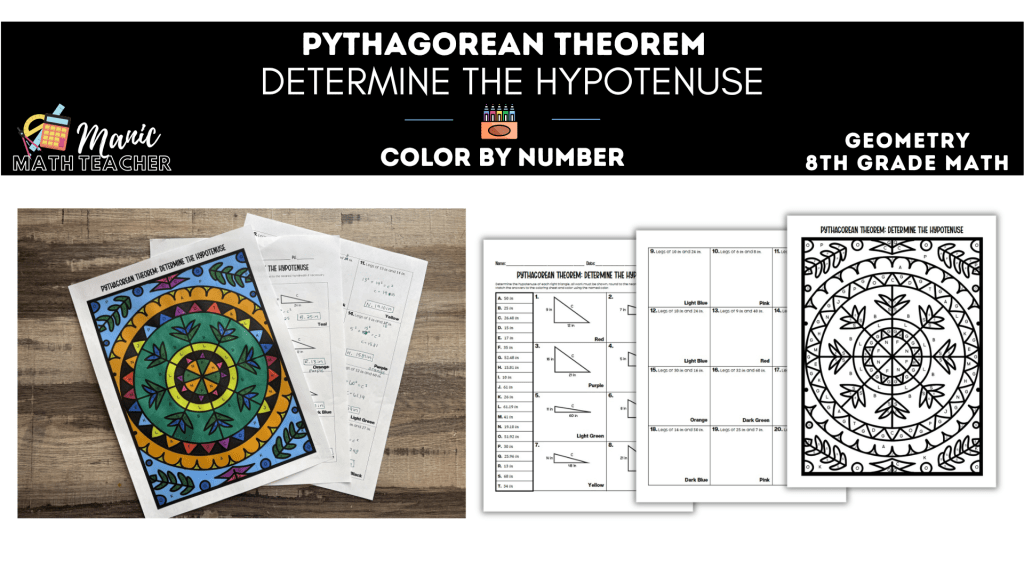
That’s why I like to use structured practice where students are given the leg lengths and asked to calculate the hypotenuse over and over in slightly different ways. In my classroom, I pair this with a color by number activity: as students solve each problem and check their work, a design gradually appears. It gives them enough repetition to build fluency, but with just enough novelty to keep them engaged.
If you’re teaching the Pythagorean Theorem this year, consider adding a dedicated “find the hypotenuse” practice day before moving on to more complex applications. You can grab my hypotenuse‑focused color by number activity on TpT and use it as a low‑prep station, review day, or sub plan.
This product can be found on my Teachers Pay Teachers Store here:


Leave a comment