
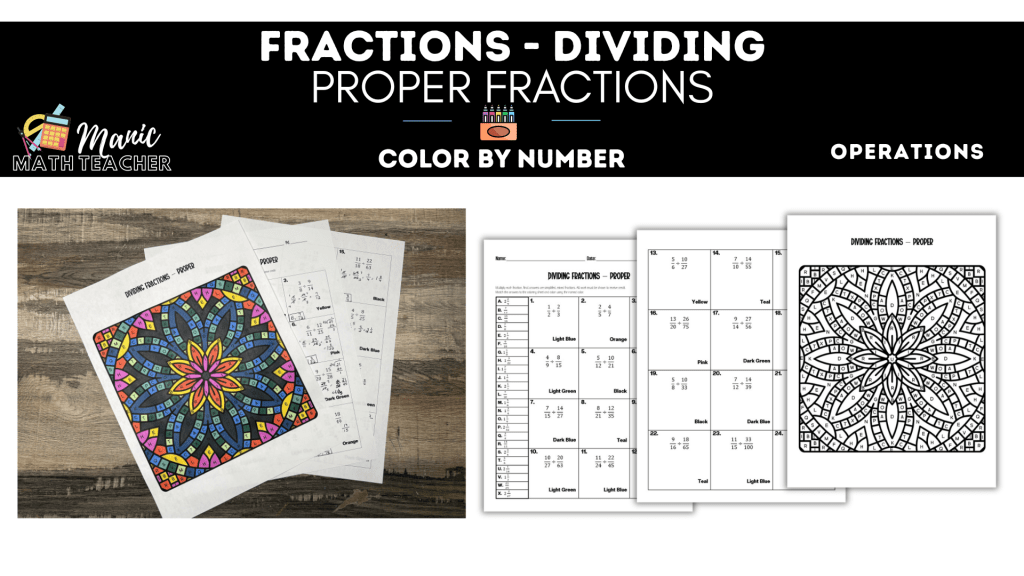
Fraction division is notoriously challenging for students. The “keep, change, flip” procedure is easy to memorize but hard to justify. Starting with proper fractions only gives us space to talk about what division means—“how many groups?” or “how many in each group?”—before adding mixed numbers into the mix.
Pedagogically, early fraction‑division work should help students see that dividing by a fraction often produces a larger result, not a smaller one, and why that makes sense. For example, “how many halves are in 3?” is naturally more than 3.
A practice set where students divide proper fractions and write answers as a mix of simplified proper fractions and improper fractions, then convert improper results to mixed numbers, supports:
- Understanding that quotients can be more than one whole.
- Reinforcing the connection between division and multiplication by the reciprocal.
- Giving students consistent experience moving between improper and mixed forms.
My color by number activity on dividing proper fractions uses this structure. Students apply the division rule, simplify the quotient, convert when needed, and verify answers in the bank before coloring. The repetition builds familiarity with fraction division without turning class into a pure procedural drill.
This product can be found on my Teachers Pay Teachers Store here:


Leave a comment