
Ask a class of 8th graders about distance and slope, and you’ll often hear the same mix‑ups: “Is that rise over run?” “Is that the length?” It’s no surprise—both concepts involve two points on a coordinate plane, and both use differences in x and y. The difference lies in what question we’re asking: How far apart are the points? or How steep is the line between them?
Instructional research suggests that directly contrasting similar concepts can help students form clearer mental categories. When we put distance and slope side by side, students are forced to decide which formula to use and why, instead of memorizing them in isolation.
To build this contrast, I like to give tasks where students must calculate both distance and slope for each pair of points or graph. They see quickly that:
- Distance is about length and is always non‑negative.
- Slope is about steepness and direction and can be positive, negative, zero, or undefined.
- Both use differences in x and y, but in different roles.
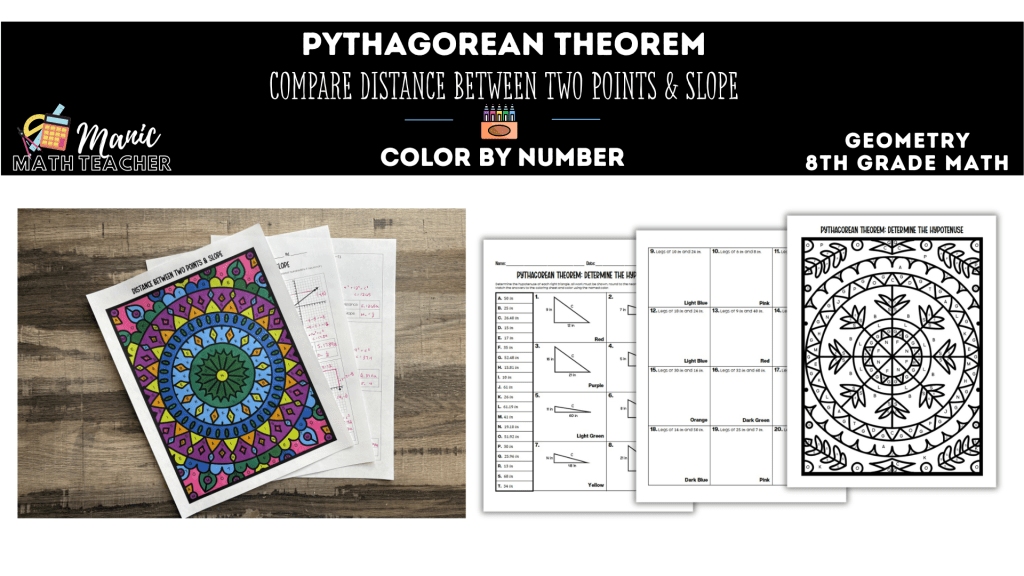
A color by number activity is a neat way to organize this kind of dual practice. Each problem requires two answers—distance and slope—to complete the pattern. If one is off, the answer bank reveals it before they get too far, and they can correct their work.
If distance and slope tend to blur together in your students’ minds, a focused compare‑and‑contrast practice like my distance‑and‑slope color by number resource on TpT can help resolve that confusion.
This product can be found on my Teachers Pay Teachers Store here:


Leave a comment