
Triangle work in middle school often feels fragmented: one day it’s side lengths, another day it’s area, then perimeter shows up somewhere else. But research on coherence in math curricula suggests that students benefit when we help them see these ideas as connected pieces of a bigger picture.
Right, isosceles, and scalene triangles give us a natural way to tie together side lengths, area, and perimeter. When students use the Pythagorean Theorem to find a missing side and then immediately use that side in area and perimeter calculations, they’re practicing both geometry and number sense within the same problem.
This kind of task does a few things at once:
- Reinforces the structure of right triangles hidden inside other triangle types.
- Encourages students to track measurements across multiple steps.
- Builds fluency with formula use without feeling like separate, disconnected exercises.
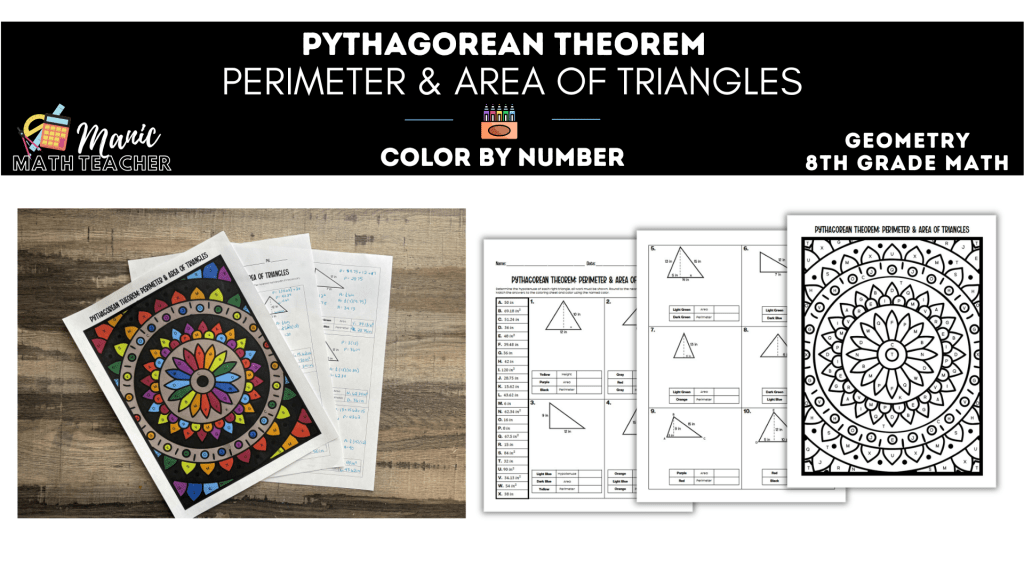
In my classroom, I like to use a set of multi‑step problems where students first find missing sides and then calculate the triangle’s area or perimeter. A color by number format works especially well here, because students need to keep track of each answer and see how they all fit together to complete the design.
If you’re looking for an activity that ties together Pythagorean Theorem, area, and perimeter in one place, my triangle‑based color by number resource on TpT can serve as a ready‑to‑go practice or assessment.
This product can be found on my Teachers Pay Teachers Store here:


Leave a comment