
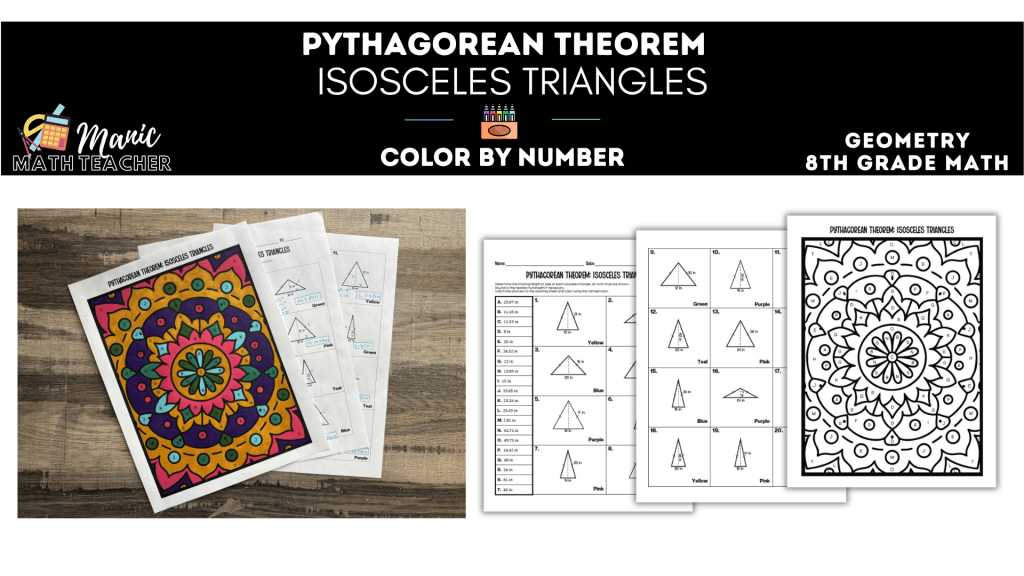
Isosceles triangles are a great context for helping students see right triangles “hiding” inside other shapes. When we drop a height from the vertex to the base, students suddenly have two congruent right triangles to work with—and that’s exactly where the Pythagorean Theorem comes back into play.
Cognitive science tells us that students are more likely to transfer skills when they see those skills in different but related contexts. Using isosceles triangles to revisit Pythagorean relationships helps students realize that the theorem isn’t just about one specific triangle picture—it’s about any situation where a right angle and three connected sides appear.
Practice tasks where students are given the base and height, or the base and slant height, and asked to find the missing measure push them to:
- Visualize how the height splits the base.
- Use right‑triangle reasoning inside a larger shape.
- Keep track of which segment lengths belong to which part of the triangle.
To keep things manageable, I like to turn these into a color by number activity. Each problem focuses on one isosceles triangle diagram, and students have to decide which measure to find and how to apply the theorem correctly before they can move on.
If you’re preparing students for more advanced geometry, regular exposure to isosceles triangles in this way can pay off later. You can find my isosceles‑focused color by number practice on TpT if you’d like a ready‑made set.
This product can be found on my Teachers Pay Teachers Store here:


Leave a comment