
Finding common denominators is a major turning point in fraction instruction. When students move from “the denominators already match” to “I have to make them match,” the risk is that the process feels arbitrary and purely procedural. Our job is to help them see why common denominators matter.
Pedagogical research on fractions stresses the importance of visual and conceptual support when introducing unlike denominators. Students need to understand that we’re creating equivalent fractions so that we’re comparing or combining equal‑sized pieces.
A focused set of problems with proper fractions and uncommon denominators, where all answers are simplified proper fractions, helps students:
- Practice generating equivalent fractions with appropriate common denominators.
- See that the numerator changes while the denominator represents the new “size” of each piece.
- Develop fluency with simplifying after the operation.
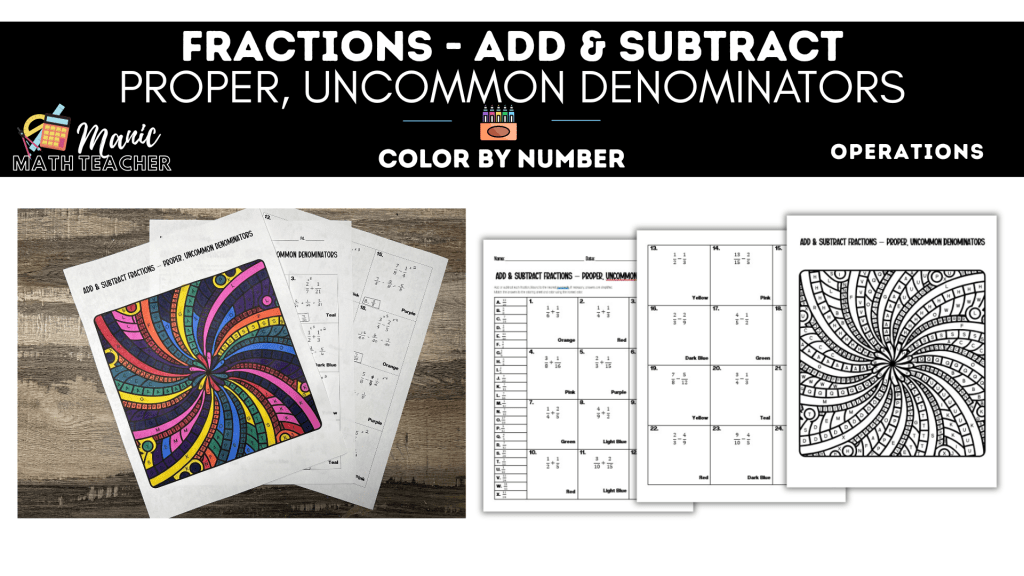
In my color by number activity, each problem requires students to pick a common denominator, rewrite the fractions, add or subtract, and simplify. The answer bank and coloring step give them immediate feedback on whether their choice of denominator and simplification were correct, turning what can feel like a dry skill into something more interactive.loring. This builds comfort with both forms and reinforces that mixed numbers and improper fractions are two ways of describing the same quantity.
This product can be found on my Teachers Pay Teachers Store here:


Leave a comment