
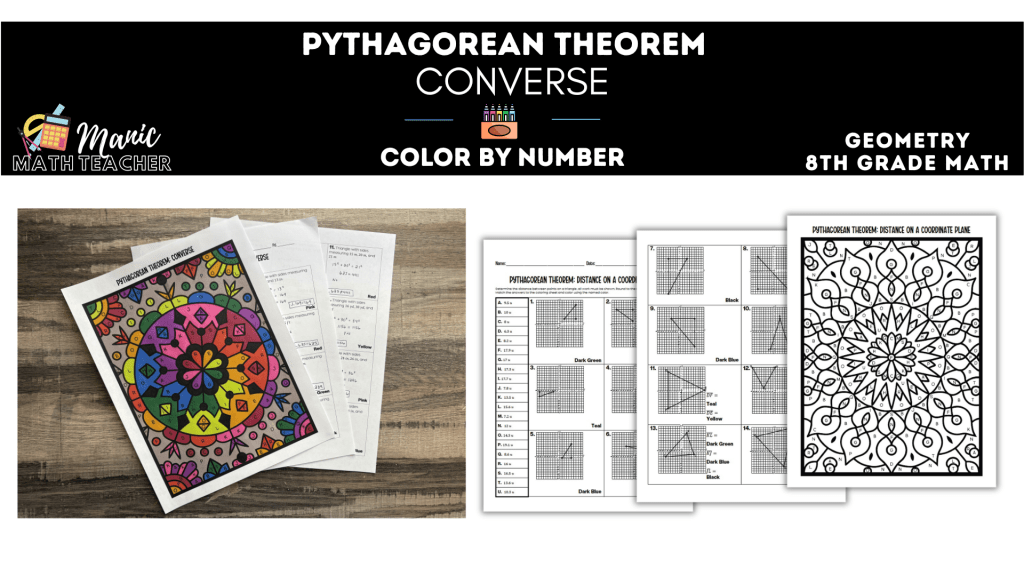
The converse of the Pythagorean Theorem is one of those topics that can either clarify everything or make students’ eyes glaze over. The key is to frame it as a simple question: “If I give you three side lengths, can they make a right triangle?”
Research on reasoning and proof in middle school math highlights the importance of giving students chances to test and classify examples. When they check whether holds for a triple of numbers, they’re essentially doing a small proof: confirming or denying right‑triangle status based on evidence.
To build this skill, I give students sets of three side lengths and ask them to:
- Identify the longest side.
- Check whether the relationship is true.
- Decide whether the triangle is right or not.
Repeating this across many examples helps them see patterns, like common Pythagorean triples, and reinforces the idea that not every triangle is right—even if the numbers look “nice.”
Using a color by number format for this practice adds a bit of structure and accountability. Each decision (right triangle or not) leads to a specific entry in the answer bank, and incorrect reasoning stalls their progress on the design, nudging them to recheck their work.
If your students struggle to remember what the converse is or when to use it, a focused practice set like my Pythagorean converse color by number activity on TpT can make the concept much more concrete.
This product can be found on my Teachers Pay Teachers Store here:


Leave a comment