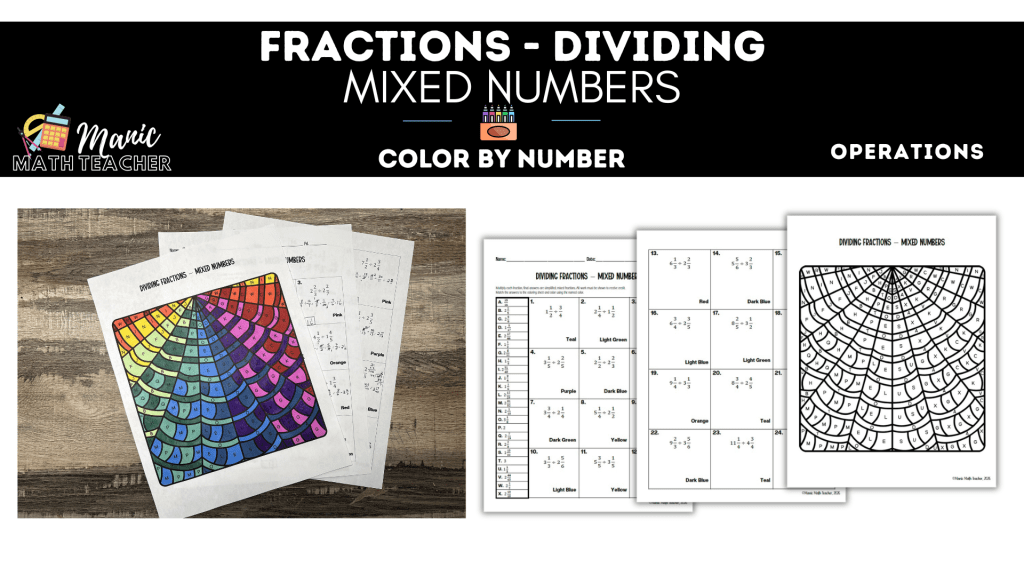
• Dividing mixed numbers is one of the more demanding fraction skills we teach in middle school. Students must convert mixed numbers to improper fractions, apply the division rule, simplify, and convert back—all while keeping track of multiple steps and avoiding common errors.

    From a teaching standpoint, this is a powerful check on conceptual understanding. Students who can successfully divide mixed numbers and interpret the resulting quotient have a strong foundation for later algebra work.

    A practice set where all expressions are mixed numbers, and students:

    • Convert each mixed number to an improper fraction.
    • Use “keep, change, flip” and cross simplifying.
    • Simplify the quotient and convert back to a mixed number,

    helps solidify:

    • The relationship between multiplication and division with fractions.
    • The idea that quotients can be proper fractions, improper fractions, or mixed numbers.
    • Students’ confidence in handling multi‑step fraction operations.

    My color by number resource for dividing mixed numbers is designed to walk students through this full process 20 times. The answer bank helps catch mistakes, and the coloring component keeps them motivated to finish, making it a strong culminating activity for your fraction unit.


    This product can be found on my Teachers Pay Teachers Store here:
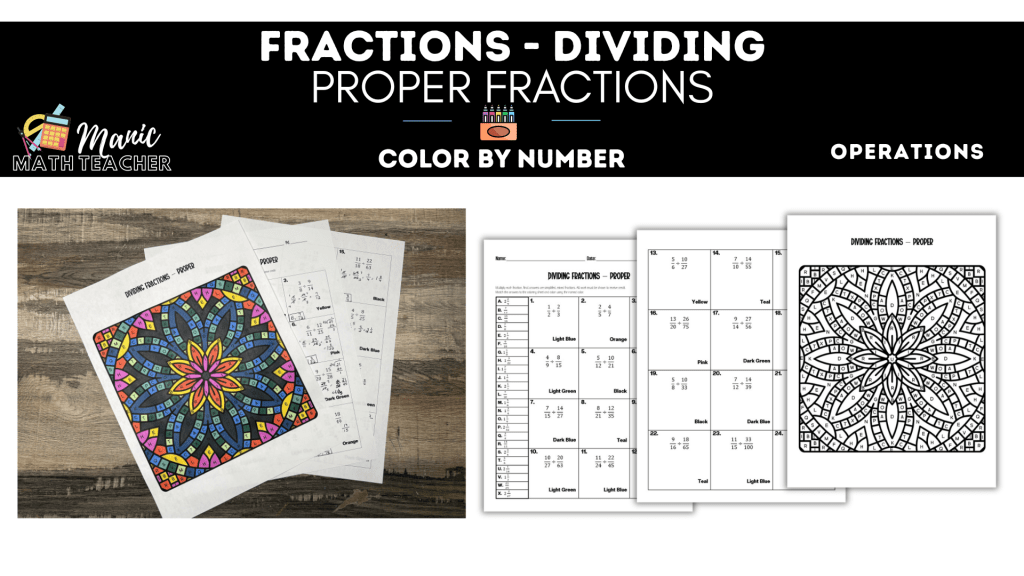

  • Fraction division is notoriously challenging for students. The “keep, change, flip” procedure is easy to memorize but hard to justify. Starting with proper fractions only gives us space to talk about what division means—“how many groups?” or “how many in each group?”—before adding mixed numbers into the mix.

    Pedagogically, early fraction‑division work should help students see that dividing by a fraction often produces a larger result, not a smaller one, and why that makes sense. For example, “how many halves are in 3?” is naturally more than 3.

    A practice set where students divide proper fractions and write answers as a mix of simplified proper fractions and improper fractions, then convert improper results to mixed numbers, supports:

    • Understanding that quotients can be more than one whole.
    • Reinforcing the connection between division and multiplication by the reciprocal.
    • Giving students consistent experience moving between improper and mixed forms.

    My color by number activity on dividing proper fractions uses this structure. Students apply the division rule, simplify the quotient, convert when needed, and verify answers in the bank before coloring. The repetition builds familiarity with fraction division without turning class into a pure procedural drill.


    This product can be found on my Teachers Pay Teachers Store here:
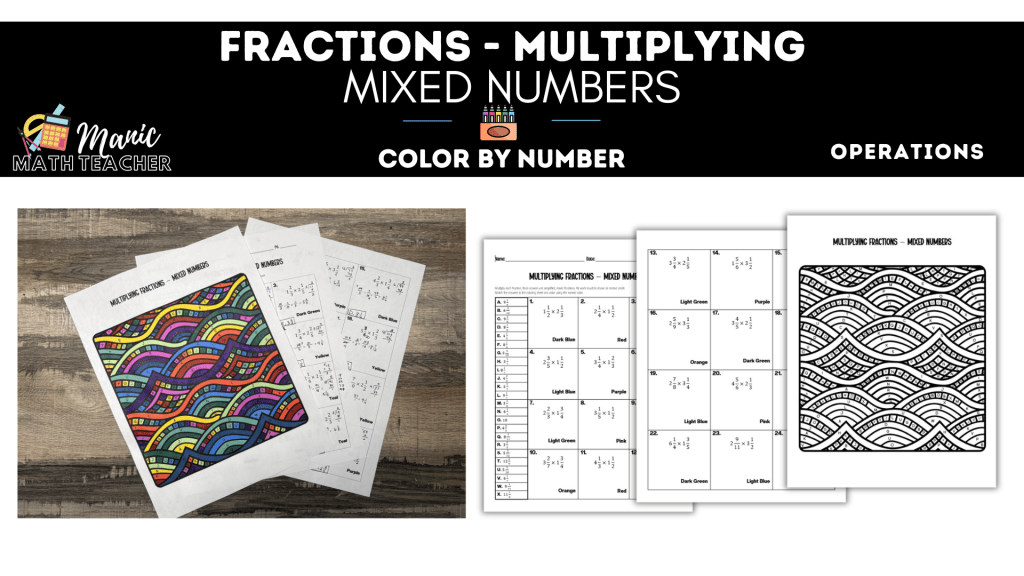

  • Multiplying mixed numbers asks students to use nearly every fraction skill they’ve learned: converting forms, simplifying, and performing multi‑step operations. That makes it an ideal capstone topic for fraction multiplication.

    From a pedagogy standpoint, this is where we see whether students truly understand the structure:

    1. Convert mixed numbers to improper fractions.
    2. Cross simplify where possible.
    3. Multiply the numerators and denominators.
    4. Convert the product back to a mixed number.

    A focused practice set with mixed numbers only, where students must follow this full process and express all final answers as mixed numbers, helps them:

    • See multiplication as a sequence of meaningful steps rather than a single rule.
    • Strengthen their understanding of how improper fractions relate to mixed numbers.
    • Build confidence in handling more complex fraction expressions.

    My color by number resource for multiplying mixed numbers gives students 20 opportunities to walk through this sequence. The built‑in answer bank and coloring step make it feel less intimidating while still preserving the rigor of the task.


    This product can be found on my Teachers Pay Teachers Store here:
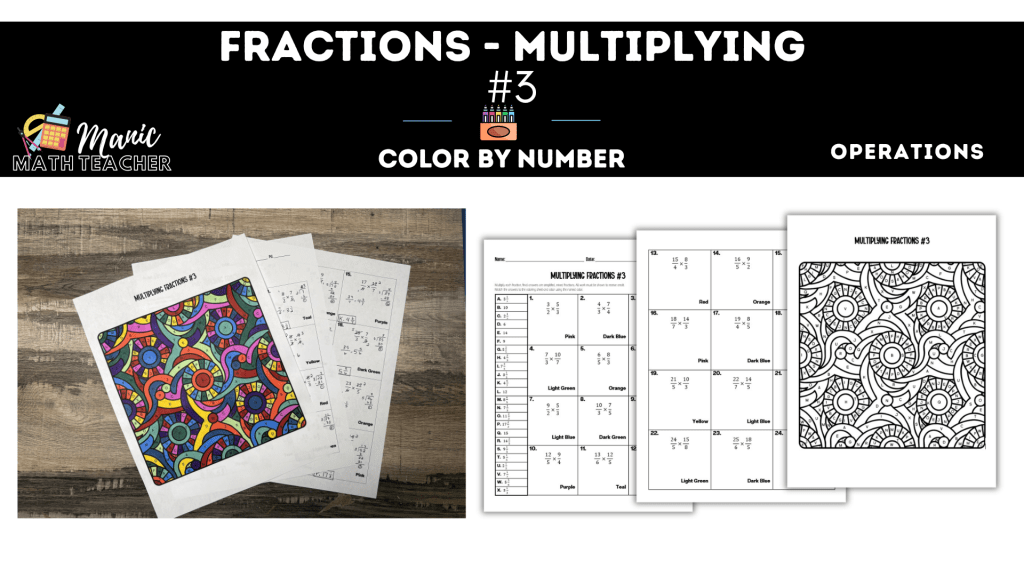

  • Multiplying combinations of improper and proper fractions helps students explore products that are larger than one whole and see how multiplication can increase quantity beyond simple “parts of a whole.” This is a key step toward understanding fractions on the number line and in real‑world contexts.

    Instructional research suggests that students need regular opportunities to move between improper fractions and mixed numbers. When multiplication problems naturally produce improper results, converting to mixed numbers reinforces that understanding.

    In this practice level:

    • Problems feature combinations of proper and improper fractions.
    • Students may cross simplify before multiplying.
    • All products first appear as improper fractions and must be converted to mixed numbers.

    My color by number activity for this topic gives students repeated practice with this full process: simplify, multiply, and convert. The answer bank ensures they’ve written their mixed‑number answers correctly before moving on to color, which nudges them to check their conversions carefully.


    This product can be found on my Teachers Pay Teachers Store here:
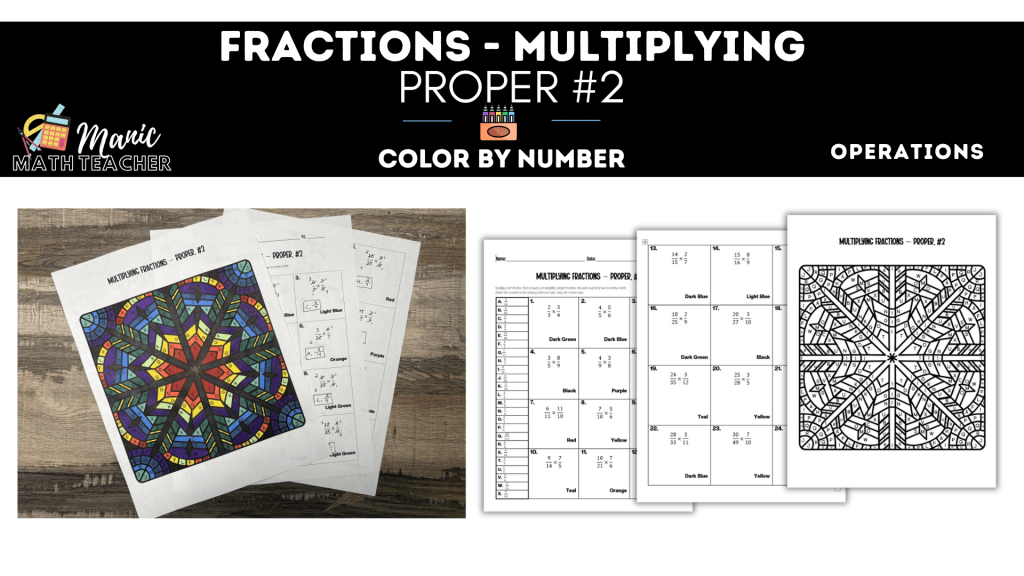

  • MultiplyOnce students can multiply proper fractions, many of us introduce cross simplifying (or cross‑cancelling) to make the arithmetic cleaner and more efficient. This strategy doesn’t just reduce computation; it also highlights the role of common factors and reinforces students’ understanding of simplification.

    Pedagogically, cross simplifying works best after students have a solid grasp of basic multiplication. They can then learn to look “diagonally” for common factors, simplify before multiplying, and see how this leads to smaller, more manageable products.

    A practice set where students multiply proper fractions and are encouraged to cross simplify, with all answers written as simplified proper fractions, helps them:

    • Identify and reduce common factors before performing full multiplication.
    • Build number sense around factors and divisibility.
    • Strengthen their ability to check whether an answer is truly in lowest terms.

    My color by number resource for this level reinforces cross simplifying repeatedly. Students simplify, multiply, and then confirm their products using the answer bank. Over time, they begin to see cross simplifying as a natural part of fraction multiplication, not an extra trick.


    This product can be found on my Teachers Pay Teachers Store here:
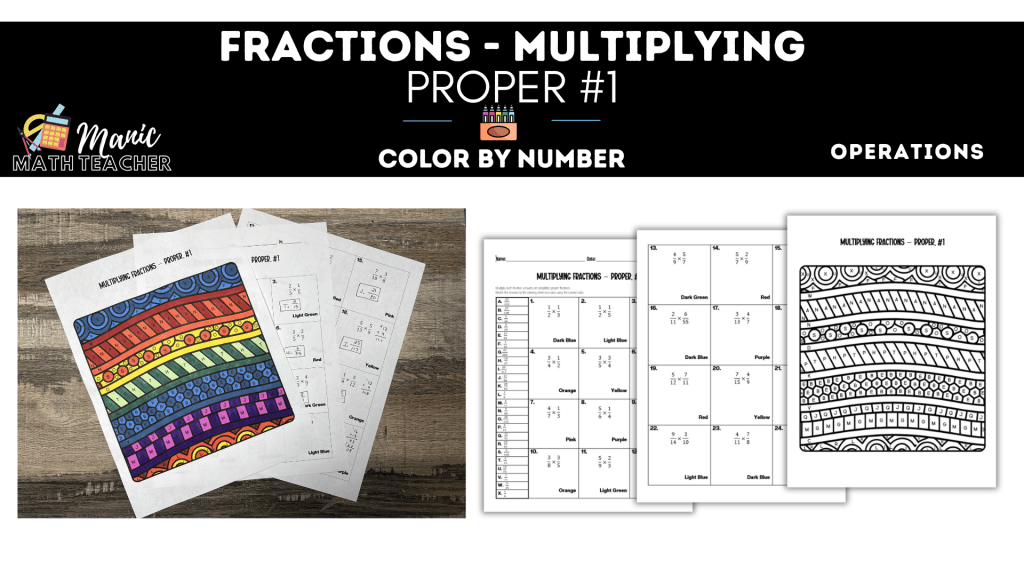

  • Multiplying fractions is often more intuitive than adding or subtracting once students understand what it represents: taking a part of a part. Starting with proper fractions only lets us focus on the core rule—multiply numerators, multiply denominators—and what the result means.

    Research on fraction instruction suggests that students benefit from clear, simple contexts when first learning multiplication. They need repeated exposure to the idea that ab×cd\frac{a}{b} \times \frac{c}{d}​ gives a smaller number than either fraction alone (in most cases), and that the product should be simplified.

    A practice set with proper fractions only, where all answers are simplified proper fractions, supports:

    • Solidifying the “multiply straight across” procedure.
    • Reinforcing simplification as a natural final step.
    • Helping students anticipate reasonable product sizes.

    My color by number activity for this topic gives students 20 proper‑fraction multiplication problems and an answer bank to check their work. By pairing the computation with a design, students stay engaged long enough to build meaningful fluency.ons.


    This product can be found on my Teachers Pay Teachers Store here:
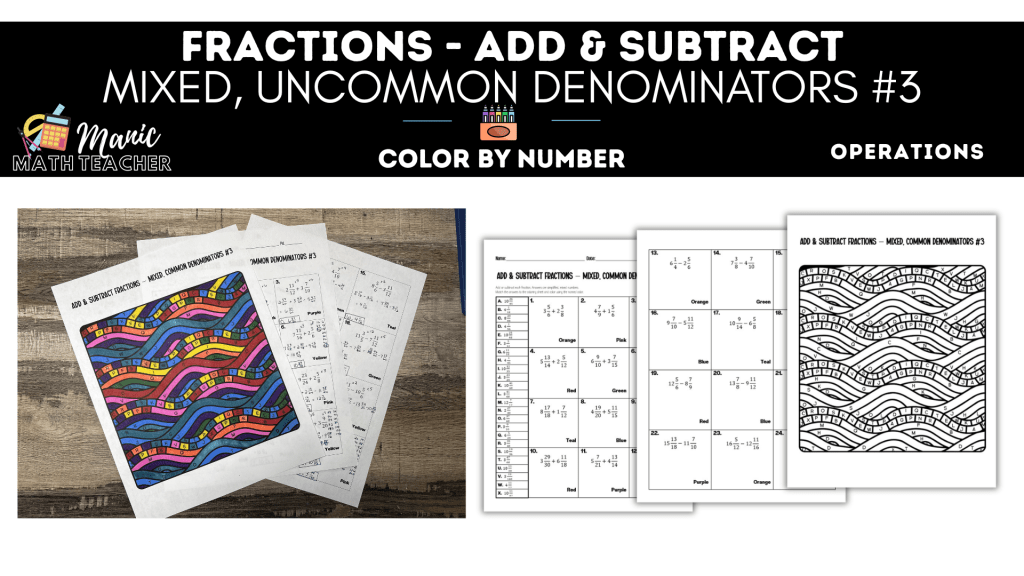

  • Regrouping is often where mixed‑number subtraction falls apart. Students know they need to “borrow” from the whole number, but the fraction piece feels fragile and confusing. Giving them guided, focused practice with regrouping in the context of unlike denominators can dramatically improve their confidence.

    Effective fraction pedagogy emphasizes making regrouping concrete: students need to understand that borrowing one whole means adding an equivalent fraction (like 44\frac{4}{4}44​ or 55\frac{5}{5}55​) to the fractional part, not simply rearranging numbers.

    A high‑level practice set with mixed numbers, uncommon denominators, and required regrouping, where all answers are simplified mixed numbers, helps students:

    • See regrouping as a consistent, logical process.
    • Combine common‑denominator work with careful borrowing when subtracting.
    • Develop perseverance and attention to detail in multi‑step fraction problems.

    My color by number activity for this level explicitly builds in regrouping. Students must choose common denominators, convert whole units to fraction equivalents when needed, subtract and simplify, then check their results in the answer bank. Over 20 problems, they start to see patterns and gain confidence in handling “messier” subtraction questions.


    This product can be found on my Teachers Pay Teachers Store here:
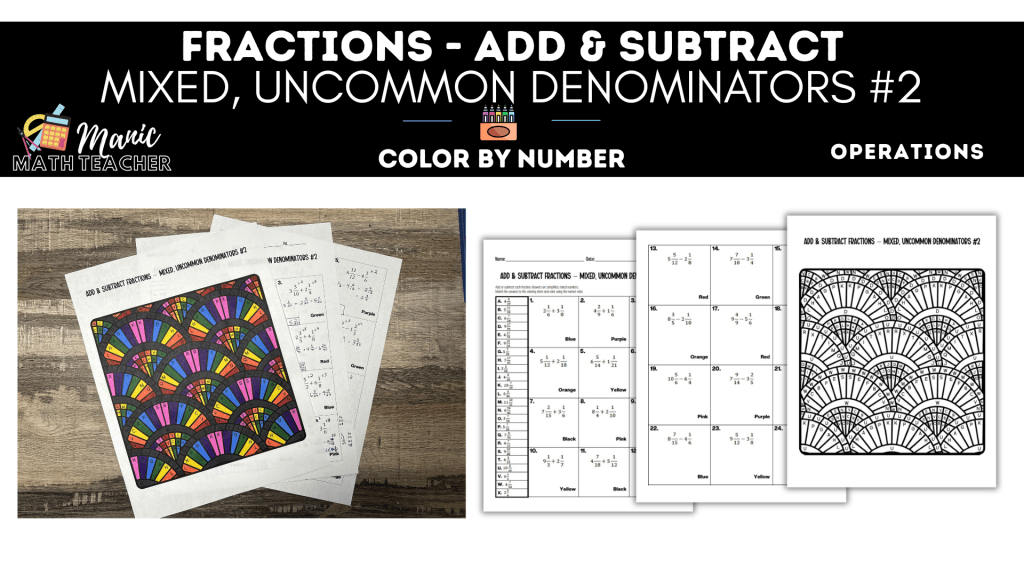

  • Once students understand common denominators with proper fractions, we inevitably As students grow more comfortable with mixed numbers and unlike denominators, we can gradually increase the complexity of the problems. Level 2 tasks might involve less “nice” denominators, more opportunities for simplification, and more attention to detail in combining wholes and parts.

    The goal at this stage is not just correct answers, but resilience—students sticking with multi‑step fraction problems and checking their work carefully.

    A practice set labeled as advanced mixed‑number operations with uncommon denominators, where answers must be simplified mixed numbers, supports:

    • Deeper fluency with equivalent fractions.
    • Continued practice tracking whole numbers through multi‑step computations.
    • Stronger habits around simplification and error checking.

    In my corresponding color by number activity, problems are deliberately a “level up.” Students still find common denominators and simplify, but the numbers push them a bit more, encouraging thoughtful work rather than automatic procedures. The answer bank and coloring design again provide built‑in feedback and motivation.


    This product can be found on my Teachers Pay Teachers Store here:
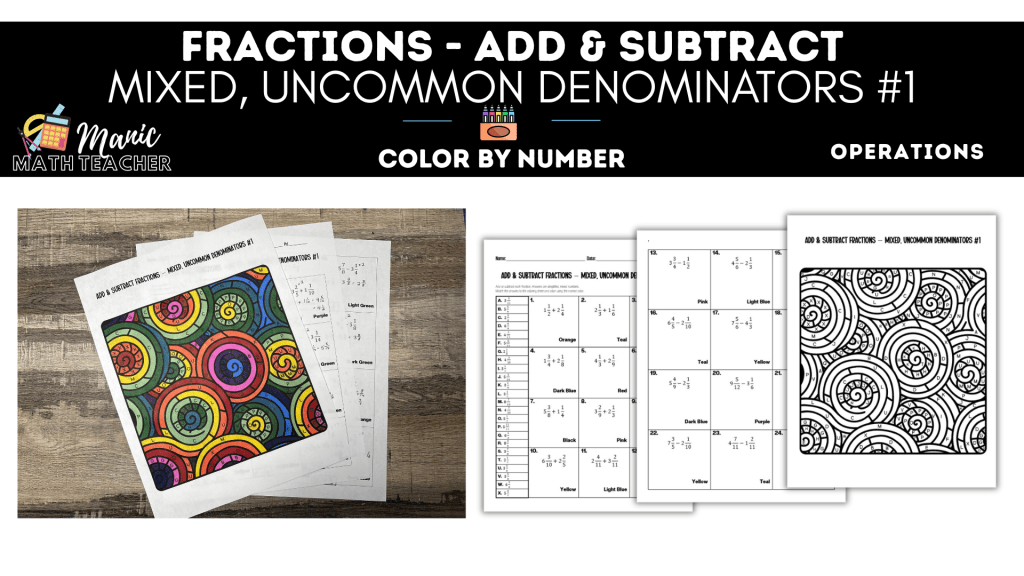

  • Once students understand common denominators with proper fractions, we inevitably ask them to bring that skill into mixed‑number operations. This is a classic “two‑skill” situation: they must manage whole numbers and fractional parts while also finding common denominators.

    Teaching mixed numbers with unlike denominators is easier when we introduce it in stages. Level 1 problems should be reasonably straightforward—students find a common denominator, rewrite the fractional parts, then add or subtract along with the whole numbers, and finally simplify.

    A practice set featuring mixed numbers with uncommon denominators, where all final answers are simplified mixed numbers, helps students:

    • Apply their common‑denominator knowledge in a more complex context.
    • Strengthen their ability to track whole numbers and fractional parts through multiple steps.
    • Practice simplification as the final polish on each problem.

    My color by number resource for this level keeps the structure consistent. Students move through 20 mixed‑number problems, each requiring common denominators and simplification, and use the answer bank to verify their work. It’s a great next step after students feel solid with proper fractions and ready to stretch into mixed numbers.e interactive.loring. This builds comfort with both forms and reinforces that mixed numbers and improper fractions are two ways of describing the same quantity.


    This product can be found on my Teachers Pay Teachers Store here:
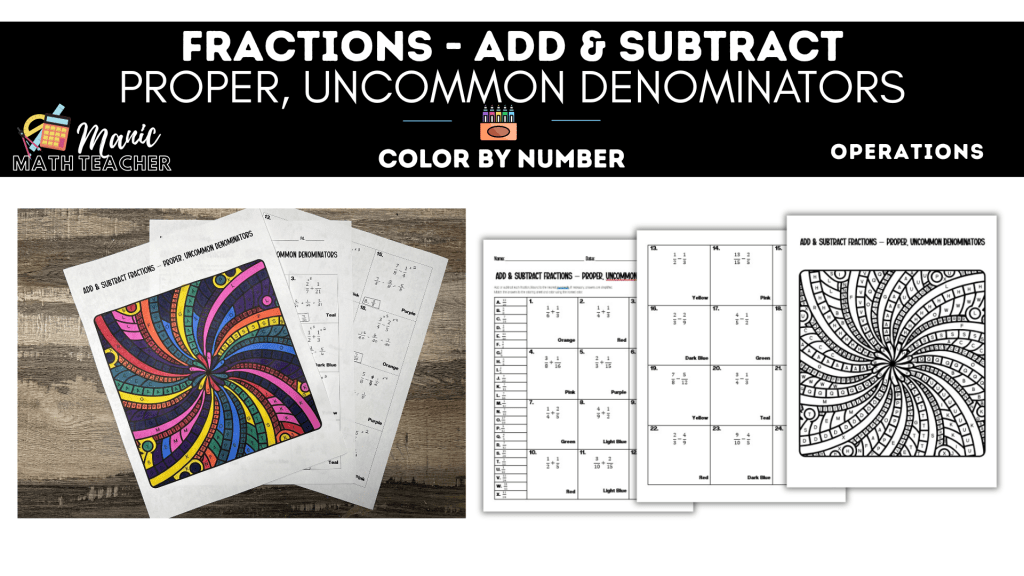

  • Finding common denominators is a major turning point in fraction instruction. When students move from “the denominators already match” to “I have to make them match,” the risk is that the process feels arbitrary and purely procedural. Our job is to help them see why common denominators matter.

    Pedagogical research on fractions stresses the importance of visual and conceptual support when introducing unlike denominators. Students need to understand that we’re creating equivalent fractions so that we’re comparing or combining equal‑sized pieces.

    A focused set of problems with proper fractions and uncommon denominators, where all answers are simplified proper fractions, helps students:

    • Practice generating equivalent fractions with appropriate common denominators.
    • See that the numerator changes while the denominator represents the new “size” of each piece.
    • Develop fluency with simplifying after the operation.

    In my color by number activity, each problem requires students to pick a common denominator, rewrite the fractions, add or subtract, and simplify. The answer bank and coloring step give them immediate feedback on whether their choice of denominator and simplification were correct, turning what can feel like a dry skill into something more interactive.loring. This builds comfort with both forms and reinforces that mixed numbers and improper fractions are two ways of describing the same quantity.


    This product can be found on my Teachers Pay Teachers Store here: